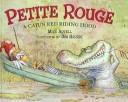

Kristin Zourkas reviewed Petite Rouge by Mike Artell
"Back in de swamp where dat Spanish moss grow, I heard me a story from long time ago"
5 stars
Petite Rouge: A Cajun Red Riding Hood is written by Mike Artell and illustrated by Jim Harris. It was awarded Read Aloud Book of the Year by the National Association of Elementary School Principals in 2009 and the Storytelling World Resource Award Honor Book in 2002. It even was adapted as a play for its many story elements!
I really enjoyed reading Petite Rouge: A Cajun Red Riding Hood because Artell incorporates rich dialect into the story that really made me feel like I was experiencing Cajun culture! I would consider this a variant of the traditional literature of “Little Red Riding Hood” because it differs by culture and time period. This book has a contemporary lens on Cajun culture yet still retains the tale’s integrity/plot.
Instead of having a young girl play red riding hood, there is a young duck named “Petite Rouge” who goes on a journey with …
Petite Rouge: A Cajun Red Riding Hood is written by Mike Artell and illustrated by Jim Harris. It was awarded Read Aloud Book of the Year by the National Association of Elementary School Principals in 2009 and the Storytelling World Resource Award Honor Book in 2002. It even was adapted as a play for its many story elements!
I really enjoyed reading Petite Rouge: A Cajun Red Riding Hood because Artell incorporates rich dialect into the story that really made me feel like I was experiencing Cajun culture! I would consider this a variant of the traditional literature of “Little Red Riding Hood” because it differs by culture and time period. This book has a contemporary lens on Cajun culture yet still retains the tale’s integrity/plot.
Instead of having a young girl play red riding hood, there is a young duck named “Petite Rouge” who goes on a journey with her cat to bring gumbo and boudin to her sick grandmother. Petite Rouge goes on a small canoe (pirogue) to travel to her grandmother’s and encounters a hungry alligator named Claude on her way. Just like the Big Bad Wolf, Claude wants to gobble up Petite Rouge! I question if this would be considered a fable or a fairytale since this story only has animals as the characters. Using animals for the characters allows children to make sense of why a hungry alligator would want to eat a duck versus why a big bad wolf would want to eat a young girl.
The story follows the time order of a simple plot with a rising action, climax, and falling action like most fairytales do. This variant of Little Red Riding Hood is quite humorous between its dialect and fast-rhyme of text. I think the dialect can be difficult for young readers to try by themselves. However, this would be a great fairytale for a read aloud! The way Artell writes allows the reader to narrate the story in the Cajun dialect and gives the characters more personalities than traditional versions of Little Red Riding Hood. Since fairy tales focus on the story telling element, this is a great story for students to listen to the rhyme and dialect in the text. The oral telling of this story would definitely keep students engaged! The illustrator Jim Harris uses vibrant watercolors to compliment the Cajun culture! Most traditional literature focuses on a moral lesson with little focus on the setting. This variation highlights the setting by having many cultural elements that are important to Cajun culture (alligator, swamp, French words, rhyme, dialect, etc.) The author includes a brief history of the Cajun people and glossary for the French words at the beginning of the story to support the reader.
I would definitely use this book to teach my students about fractured tales since it offers a new cultural perspective on the traditional tale of Red Riding Hood. I would also explore with my students plot deviations since in this version Petite Rouge outsmarts the alligator by feeding him “hot-sauced boudin”. Petite Rouge is seen as clever and courageous when faced with danger. I would also use this text to explore how the sound and “feel” of this story’s culture compares/contrasts to its origin. Students can also compare the Cajun cultural elements of this text to the French/Cajun elements used in Disney Fairytales. When I was reading this tale, I found myself making connections to some of Disney tales/songs that have Cajun or French influences. I find this book best suitable for elementary students age 6-10. This would be great to use for a reader’s theater to help students practice appropriate phrase/rhyme when reading as well!